

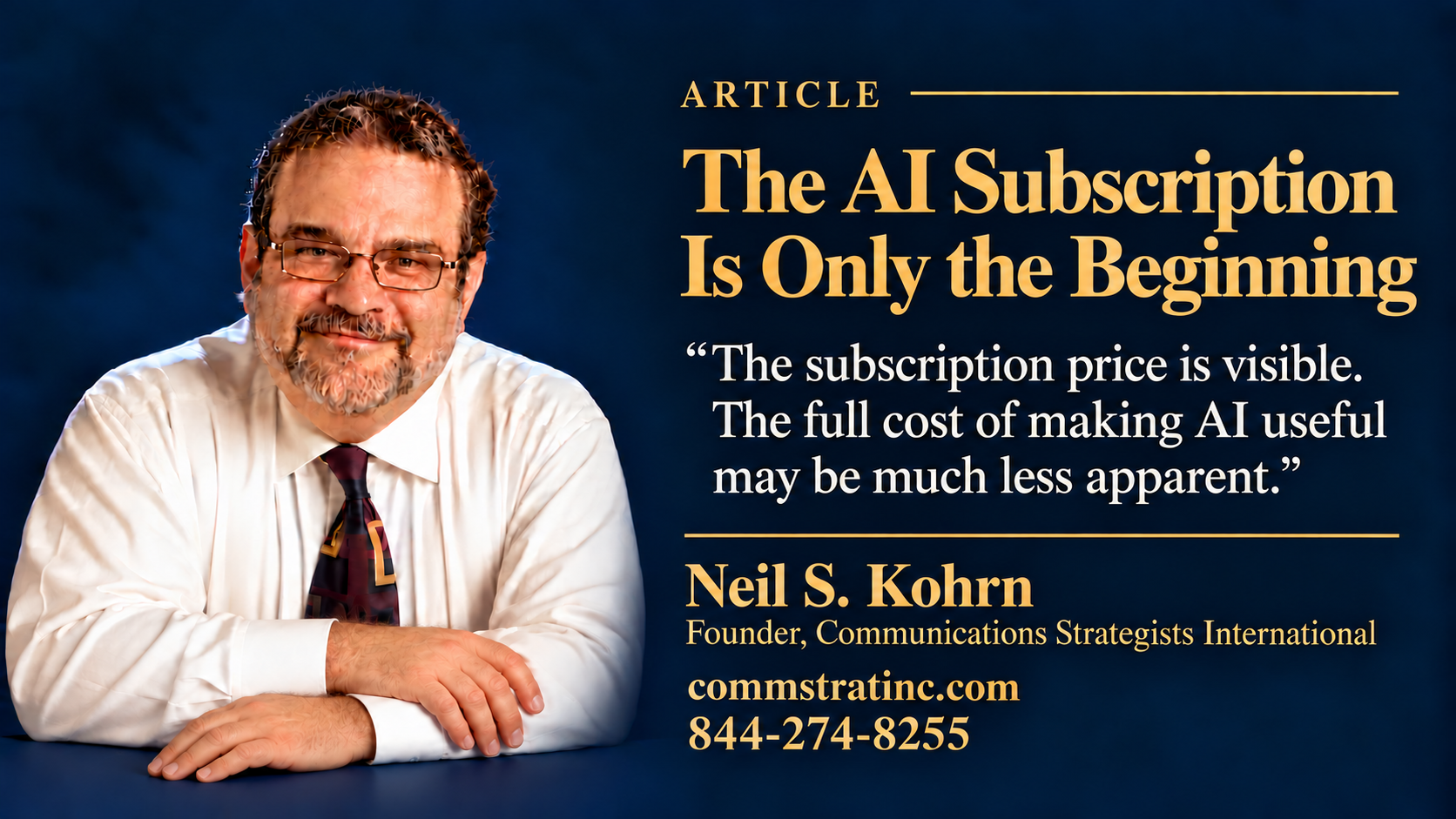
The AI Subscription Is Only the Beginning
By Neil S. Kohrn
A major misconception about artificial intelligence is that purchasing access to a platform provides everything a company needs to put it to work. Management approves a subscription, assigns someone to use it, and expects results. But the platform may represent only a small portion of the investment required.
The larger expense can come from supporting tools, additional subscriptions, licensed databases, specialized knowledge sources, and integration with existing company systems. There is also the time required to prepare information, establish working procedures, verify results, and maintain those capabilities.
The subscription price is visible. The full cost of making AI useful may be much less apparent.
Choosing Without a Complete Catalog
When purchasing a car, a buyer can review a catalog of known features, compare packages, and understand the price before committing. The available options and their intended functions are largely defined.
With AI, there is no single, complete catalog that tells a company everything it will need—or what the total cost will be. Individual products have feature lists. But which combination will serve the company’s objectives? Which information sources will be necessary? How will the tools work with existing systems? What will employees need to learn?
Those answers depend on the business, its current position, and the outcome it wants to achieve. Some requirements become apparent only after implementation begins. A company that starts purchasing tools before defining those requirements may acquire several capabilities without establishing how they will work together.
The Cost of Changing Direction
If management wants AI to perform a different function, support another department, or address a new objective, will the existing products suffice? Or will the company need additional tools, upgraded subscriptions, new knowledge sources, and further integration?
A change that sounds simple in a meeting may require considerable expense and work to deliver. Previous investments may remain useful, but they do not necessarily cover the next requirement.
Budgeting requires an understanding of both immediate needs and longer-term goals. A company cannot anticipate every future requirement, but it can evaluate how readily its chosen products accommodate change—and what that change could cost.
The People Directing AI
Selecting the person responsible for interfacing with AI requires more consideration than simply filling a position. Technical familiarity alone is insufficient. Can that person clearly communicate the company’s objectives, provide relevant context, define constraints, distinguish facts from assumptions, and recognize when a response fails to address the actual issue?
Their understanding of the business matters. A person may be highly capable within one department while having limited visibility into corporate strategy, financial priorities, or board-level concerns. That limits the context they can provide and their ability to assess the response.
When several people share responsibility, another issue arises: are they communicating consistently? They do not need to use identical words. They do need to convey consistent objectives, definitions, assumptions, and constraints. Otherwise, each person may unintentionally present AI with a different version of the company’s needs.
Neil S. Kohrn, founder of Communications Strategists International, describes this requirement as “consistent contextual communications.”
For Mr. Kohrn, that consistency is critical to effective AI use. A shared platform does not automatically create a shared understanding. The people directing it must establish and maintain that understanding, including when responsibilities change or work passes between employees.
The AI Chef

“A good chef will create tasty food. A great chef will design and present a memorable experience. The same is true of your AI chef,” Mr. Kohrn observes.
The person directing AI must understand the desired outcome, select the right ingredients, coordinate the preparation, and apply judgment throughout. With AI, those ingredients include information, context, tools, and consistent direction. Operating the tools is only part of the responsibility; bringing their capabilities together to serve the company’s objectives requires a broader understanding of the business.
An Ongoing Business Commitment
AI requires onboarding, development, and continuing attention. The company must supply relevant information, establish responsibilities, evaluate results, and adapt its approach as requirements evolve. Those activities require people, time, and money. They belong in the investment decision from the beginning.
Before committing, management should be able to explain what it wants to accomplish, what information and supporting capabilities it needs, who will direct the work, and how success will be evaluated.
Making the Investment Count
The decision to adopt AI carries a continuing commitment to the tools, information, and people required to make it useful. Management must understand that commitment before it can judge whether the investment serves the business. As objectives change, the costs and capabilities must be reassessed, while consistent contextual communications keep everyone working toward the same outcome.
The chef analogy brings those responsibilities together. A well-equipped kitchen still requires someone who understands the ingredients, coordinates the work, and knows what should reach the table. A company’s AI investment deserves the same care. The measure of success is what it delivers for the business.

Comments